

















NECEC’s First Six Months: An Assessment
Key Takeaways
- Six months in operation, the New England Clean Energy Connect (NECEC) transmission project is delivering additive clean-energy imports from Canada
- NECEC’s early outages do not undermine confidence that it will meet its long-term delivery obligations
- The transmission line is poised to reverse recent declines of Net Imports into New England, while lowering New England electricity costs and emissions.
- NECEC illustrates the larger importance of future interregional transmission to assure resource adequacy.
On January 16, 2026, with much fanfare and after a decade of planning, legal wrangling, and construction, the New England Clean Energy Connect (NECEC) transmission line began importing Québec hydropower into New England. Scarcely more than a week later, however, NECEC ceased flowing power—Hydro-Québec had curtailed power exports to meet domestic provincial electricity demand that had soared due to Winter Storm Fern’s extremely cold temperatures.1 Detractors pounced, suggesting that NECEC couldn’t be relied upon to deliver the power it was obligated to provide to New England.
Not long thereafter, NECEC came under additional criticism. Because Hydro-Québec imports and exports power from and to New England over a separate transmission line (the “Phase II” transmission line), critics suggested that power exported to Québec via Phase II was offsetting the hydropower imported via NECEC, and that on a net basis NECEC imports were not making a meaningful contribution to New England’s electricity supply.2 NECEC hydropower imports, these critics claimed, were not “additive.”
Six months after NECEC commenced operations, it is possible to put these criticisms into perspective: despite early service interruptions, the project is delivering additive clean-energy imports into New England and underscoring the broader need for expanded interregional transmission to maintain resource adequacy.
NECEC’s Winter Delivery Guarantee
NECEC got its start in 2016 when Massachusetts enacted a statute adding a new section (Section 83D) to its landmark Green Communities Act requiring electric utilities to jointly and competitively solicit proposals for new clean energy resources.3 Section 83D further required the Massachusetts Department of Public Utilities (DPU) to make specific findings prior to approving the resulting NECEC contracts that National Grid, Eversource, and Unitil had jointly procured and awarded to H.Q. Energy Services (U.S.) Inc. (HQUS).4 Among the required findings was a determination by the DPU that the contracts “[g]uarantee energy delivery in winter months.”5 The DPU found winter deliveries were guaranteed because the NECEC contracts scheduled the import of specific megawatt hour (MWh) quantities of electricity on a monthly basis,6 and because the contracts imposed penalties on HQUS if it elected to cease MWh deliveries (unexcused “uncured delivery shortfalls”) and required HQUS to make up for gaps or reductions in MWh deliveries that occurred for reasons beyond HQUS’s control (unexcused “curable delivery shortfalls”).7 There have been both uncured (voluntary) and curable (involuntary) delivery shortfalls, in addition to a single excused outage—since NECEC entered service.
Voluntary Interruption of NECEC Import Deliveries
HQUS’s voluntary decision in January to cease flowing hydropower via NECEC to serve domestic provincial load triggered an uncured delivery shortfall: HQUS was required to pay cover damages equal to the incremental cost that National Grid, Eversource, and Unitil incurred replacing and delivering the energy HQUS chose to reserve for its own domestic customers, together with the cost of replacement environmental attributes for each MWh delivery missed. The cover damages came at a substantial premium—while the sum of average winter 2026 Day-Ahead Hub locational market prices (LMPs) and Forecast Energy Requirement Prices (FERPs) equaled $165.49/MWh,8 the combined cost of Day Ahead Hub LMPs plus FERPs during Winter Storm Fern reached as high as $1,200/MWh.9 That HQUS voluntarily took on that costly repayment obligation speaks to how acute HQUS’s need had been to serve its own provincial customers.
Involuntary Interruptions of NECEC Import Deliveries
There have been three unexcused, involuntary, curable energy shortfalls during NECEC’s first six months of operation10: April 28 (half-day, no cause attributed); May 19-May 22 (2-3 days, classified as an “emergency”)11; and May 26-June 8 (14 days, attributed to “technical difficulties”)12. Per the NECEC contracts, HQUS must cure these energy shortfalls by increasing deliveries to make up for the undelivered power, either during the same season-peak period of the current year, or the same season-peak period of the following year.13
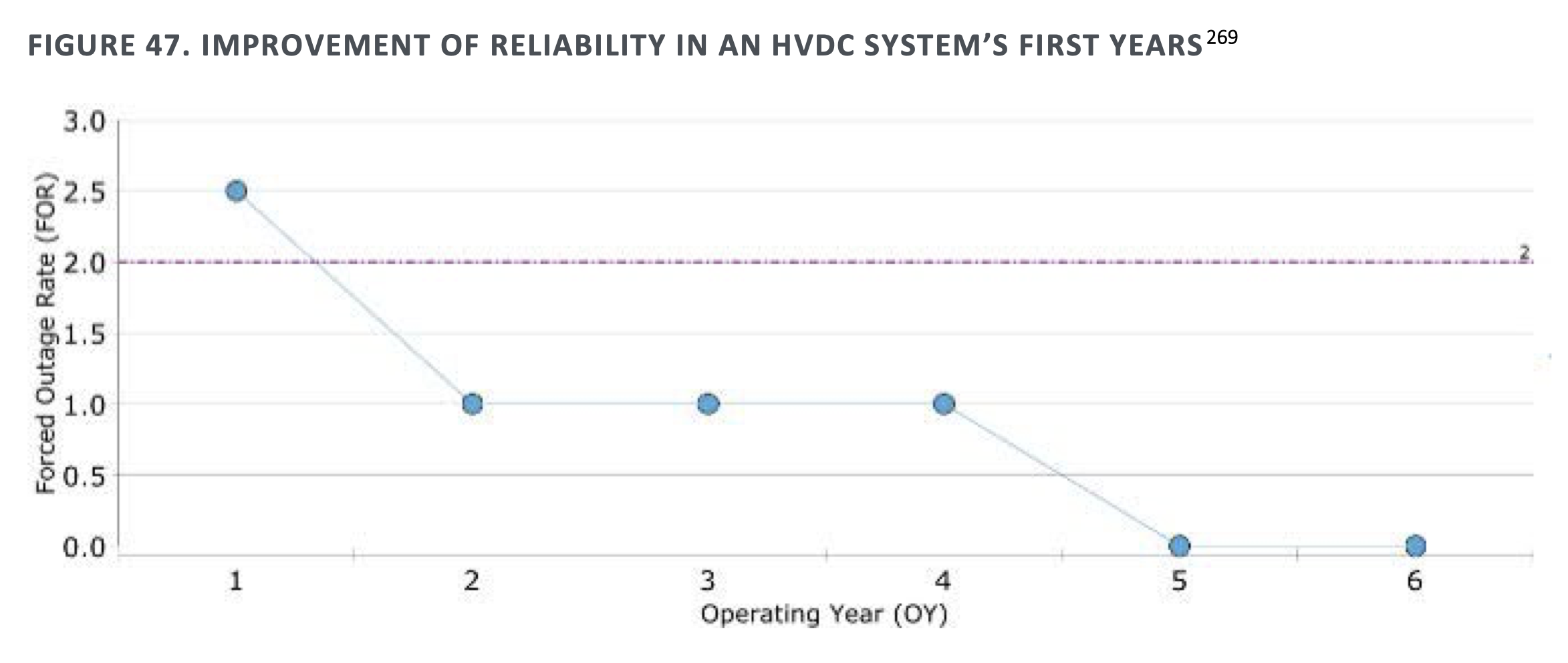
Taking January’s voluntary two-day outage and an excused nine-day outage April 8-16 for planned maintenance into account,14 there have been 17 days when NECEC power deliveries have been unexpectedly interrupted by forced outages due to equipment failures. According to a 2023 Brattle Group/DNV report on the reliability of VSC-HVDC (Voltage Source Converter-High Voltage Direct Current) transmission lines like NECEC, forced outages on new HVDC lines are to be expected—forced outage rates are higher for newly commissioned equipment, but decrease over time.15 According to the report, “[the] number of outages is higher during the first few years, then reduce[s] steadily to a low level for the majority of the equipment’s lifetime, only to increase again towards the end of life as ageing-related effects increase the failure rate again.”16
NECEC is Poised to Reverse Recent Declines of Net Imports into New England
NECEC’s excused and unexcused outages notwithstanding, it remains on track to meet its annual 9.55 TWh delivery obligation: as of July 16, NECEC had delivered 3.9 TWh into New England. A review of historic and current ISO New England (ISO-NE) external interface data indicates, moreover, that NECEC hydropower imports are not being materially offset by power exports to Québec via the Phase II line but are “additive.”
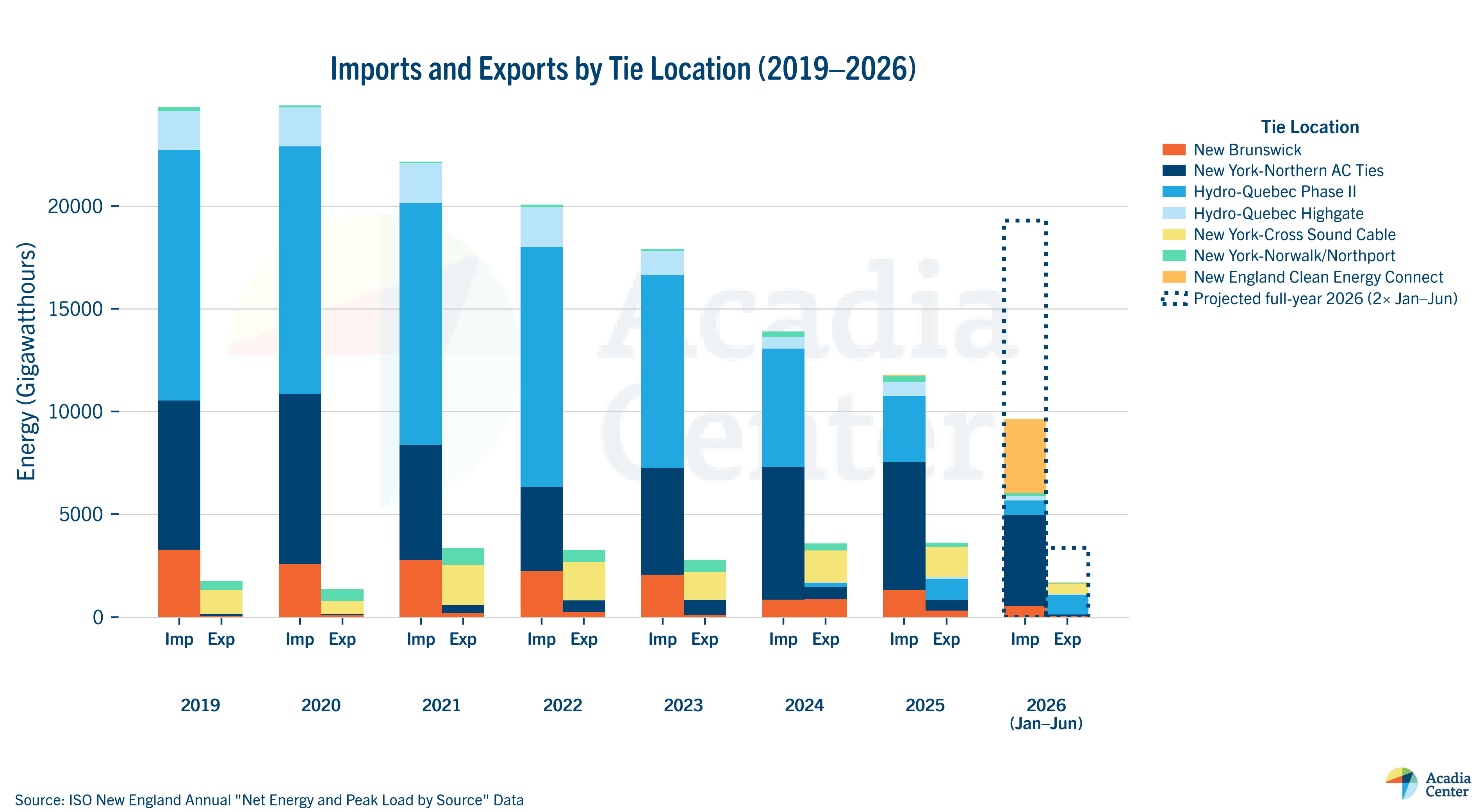
ISO-NE power Import and Export data show that Net Imports (i.e., Imports less Exports) have been declining since 2021, though not always owing to reduced Imports from Québec: in 2021 and 2022 Net Imports declined due to reduction in Imports from New York via the New York Northern AC tie. Since 2023, however, continuing declines in Net Imports have been due to reductions in Imports from Québec—specifically, reductions in Hydro-Québec Phase II Imports. Those Phase II reductions were due to an ongoing drought that began in early 2023.17 Despite successive declines in Phase II exports from 2023 through 2025—a trend that appears likely to be continued this year as well—the projection of 2026 Imports and Exports into New England to-date based on the first six months of the year indicates that 2026 Net Imports are on track to increase to their highest level since 2022, and that this reversal in Net Import declines will be due to the additive contribution of Imports received via NECEC.18
NECEC Imports are Reducing New England Electricity Prices and Emissions
NECEC is also having a real impact reducing both the cost and emissions associated with the production and consumption of electricity in New England. According to ISO-NE’s Internal Market Monitor, NECEC imports “displaced more expensive generation particularly combustion turbines and steam turbines.”19 Moreover, every MWh of NECEC imports is derived from 100% hydropower, and the NECEC contracts require the associated environmental attributes to be created, tracked, recorded and transferred in compliance with NEPOOL GIS (New England Power Pool Generation Information System) operating rules.20 According to the DPU, this requirement ensures that the utilities are purchasing “clean energy generation as defined by statute, and not system energy that contains non-clean energy generation.”21
Proposed Maine–New Hampshire Transmission Upgrades Will Ease Congestion for NECEC and Maine Onshore Wind
One early criticism of NECEC—that it would increase transmission congestion in Maine—has come to pass. According to ISO-NE’s Internal Market Monitor, the transmission interface limiting power flows from Maine into New Hampshire (the “Maine-New Hampshire interface”) rarely bound before the NECEC became operational, but last winter was constrained in more hours than previous years.22 Fortunately, the Maine-New Hampshire Interface is the subject of ISO-NE’s first Longer-Term Transmission Planning (LTTP) procurement. The RFP included an energy standard that assumed the dispatch of future northern Maine onshore wind output at 100% of nameplate value, while taking the existing and post-NECEC transfer capabilities of ISO-NE interfaces into account.23 On July 28th ISO-NE announced the preferred solution it had selected from among those submitted in response to the first LTTP Request for Proposals (RFP).24 The selected solution will be capable of accommodating 1,200 MW of onshore wind in both ISO-NE’s energy and capacity markets.25
New England is Resource and Transmission Constrained
The nexus of NECEC as an import-only transmission resource bringing 9.55 TWh per year into New England, and the objective of the first LTTP RFP to bring 1.2 GW of additional onshore wind power online, demonstrates the role that transmission plays in ensuring that the region will have sufficient resources to serve current and future demand for electricity. One way New England meets that need is power imported via regional interties—the interregional transmission that connects the region to New York and Canada. Last year Net Imports accounted for 7% of the power New Englanders consumed.26 In turn, New York and Canada rely on power that New England exports to them.27
A February 2026 North America Reliability Corporation (NERC) Interregional Transfer Capability (ITC) Study found that energy transfers via interregional transmission “play an increasingly pivotal role in supporting energy adequacy.”28 The NERC ITC study found that New England would benefit from the addition of 700 MW of interregional transfer capability with Canada, split between Québec (400 MW) and the Maritime Provinces (300 MW).29 That increase, NERC said, would “resolve all resource deficiencies identified in [its] energy margin analysis,” and added that the then just-commissioned NECEC “is likely to address a significant portion of this need.”30
NERC’s consideration of whether new interregional transfer capability a region would be a “technically prudent addition” depended on satisfying two conditions: first, a determination that the subject region was “resource deficient,” and second, a determination that a neighboring region had surplus energy to share with the deficient region after meeting its own needs.31 In light of it of Québec’s ongoing drought, and HQUS’s additional commitment to deliver hydropower into New York City,32 questions about the province’s ongoing ability to share surplus energy with neighbors after meeting its own needs will persist. The answer likely lies in Hydro-Québec’s plans to expand and diversify its generation portfolio beyond hydropower: by 2035 Hydro-Québec is planning to build 10 GW of wind power generation,33 3 GW of solar generation,34 and to implement up to 3.6 GW of energy efficiency.35 Together, these resource additions would exceed 40% of the nameplate capacity of Hydro-Québec’s current 37.4 GW resource portfolio.36 In addition to these ambitious goals, a new tentative agreement announced August 17th between Newfoundland and Labrador Hydro and Hydro-Québec would provide Hydro-Québec access to a potential 10,000 MW of projects to be constructed in Labrador–6,915 MW of them planned projects, and 3,850 MW from potential projects currently under study. Beyond Labrador and Québec, the potential for wind resource development in Nova Scotia is staggering–the province boasts 40 GW of potential generation capacity within Wind Energy Areas currently designated by the Canada-Nova Scotia Offshore Energy Regulator, with a total estimated technical wind resource potential exceeding 400 GW.37
Regional Reliability Depends on Power from Resources Beyond New England’s Borders and the Interties to Deliver It
New England is resource constrained and currently relies on neighboring New York and Canada to meet its energy requirements. The extent of NECEC’s contribution in meeting those requirements will become clear over the remaining nineteen-and-a-half-year term of its current contracts. Based on its first six months of operation, however, it is apparent that early criticism of NECEC has been premature, if not largely misplaced. Consumers are right to raise questions and seek answers – they are paying for the electricity system after all. And the adversarial nature of the process leading to the construction of NECEC shows how much the public needs credible responses to questions and concerns. The danger of that criticism isn’t merely that it may not accurately characterize NECEC’s performance to-date, but that it could cast doubts on the ability of resources outside of New England to meet the challenge of maintaining resource adequacy here in the region, within the ISO-NE control area. New York, Quebec and the Maritimes, and New England each have their own potential to develop native resources, and each have native demand to serve. At a time when resource adequacy is a primary concern for all four regions, the use of every resource, no matter where it located, must be optimized, and that can only be accomplished by increasing the transfer capacity of existing interregional transmission38 and constructing new interties to transfer power from geographically distant resources. The need to maintain reliability transcends borders. Early criticism of NECEC should not put that in doubt.
1 https://energynow.com/2026/01/extreme-cold-disrupts-hydro-quebec-exports-to-massachusetts-during-spike-in-power-use
2 https://www.renewableenergyworld.com/hydro-power/two-week-pause-of-canadian-hydropower-exposes-frailty-of-mass-plan-to-wean-off-natural-gas/
3 St. 2016, c. 188, §12 https://malegislature.gov/Laws/SessionLaws/Acts/2016/Chapter188
4 HQUS, a subsidiary of Hydro‑Québec, coordinates Hydro‑Québec’s U.S. business development and is responsible for energy transactions in Northeastern U.S. markets. https://www.hydroquebec.com/clean-energy-provider/contact.html
5 2008 Mass. Acts 169, § 83D(d)(5)(vi), added by 2016 Mass. Acts 188, § 12; 220 CMR 24.05(1)(a)6. https://malegislature.gov/Laws/SessionLaws/Acts/2016/Chapter188 and https://www.law.cornell.edu/regulations/massachusetts/220-CMR-24-05
6 The NECEC contracts require the aggregate delivery of 9.55 TWh of electricity annually. See Order re petitions for approval of long-term contracts for procurement of clean energy generation, pursuant to Section 83D of An Act Relative to Green Communities, St. 2008, c. 169, as amended by St. 2016, c. 188, § 12, Mass. Dep’t of Pub. Utils. 18-64, 18-65 & 18-66 (June 25, 2019) (the “Order”), at 76. https://fileservice.eea.comacloud.net/V3.1.0/FileService.Api/file//eddjfgee?ghkaDrcBHUOOH7NRW+IeP8EmiDhMBXK0ednWT8WFP5Ok9v9pxUxyG6LkaCeWBSjqbmMlNqhcSkxPf0qUr1gASPKrYE1qejvebf677PtCVStUdHoHpEGELGLGjR+ZpYgt
7 Id. at 81. See also “…the baseline hydroelectric generation quantities do not represent expected deliveries into New England, but rather a level of deliveries below which penalties will be assessed to HQUS,” at 61.
8 The winter 2026 average Day Ahead Hub LMPs and average FER Prices were $147.99 and $17.50, respectively. 2026 Winter Quarterly Markets Report, ISO New England (July 9, 2026), Table 2-1: High-level Market Statistics, at 31. https://www.iso-ne.com/static-assets/documents/100037/a02_2026_07_21_mc_winter_2026_qmr_report.pdf
9 Id., Figure 1-6: Day-Ahead and Real-Time Hub Prices during Winter Storm Fern, at 17.
10 The nine-day April 8-16 outage was planned to perform maintenance and was thus an excused, not an unexcused, outage. See the Order at 78, fn. 52, and the Draft Minutes of the March 5, 2026, NEPOOL Participants Committee meeting at 5241. https://www.iso-ne.com/static-assets/documents/100034/npc-2026-04-09-supplemental.pdf
11 Tim Ennis, The emergency NECEC outage has been added to the ISO-NE Short Term Outage report, with an expected return to service date of 5/21/26 23:59, GridStatus, (May 20, 2026) https://www.gridstatus.io/insights/44672197878
12 Sarah Shemkus, Is New England’s New Hydropower Transmission Line Paying Off?, Canary Media (June 16, 2026), https://www.canarymedia.com/articles/transmission/new-england-hydropower-transmission-line
13 See the Order at 79. “In addition, the [contracts] provide for an annual reconciliation of the difference between the weighted average LMP [locational marginal price] for each curable delivery shortfall and the weighted average LMP value of the curable shortfall energy deliveries.”
14 See fn. 10, above.
15 Johannes P. Pfeifenberger et al., The Operational and Market Benefits of HVDC to System Operators (The Brattle Grp. & DNV Sept. 2023), https://acore.org/wp-content/uploads/2023/09/The-Operational-and-Market-Benefits-of-HVDC-to-System-Operators.pdf
16 Id. at 146-47.
17 Jon Lamson, Drought, Climate Drive Uncertainty on New England Imports from Québec, RTO Insider (July 2, 2025), https://www.rtoinsider.com/108561-drought-climate-drive-uncertainty-ne-imports-quebec/
18 When considering whether the hydropower delivered via NECEC would be additive, the DPU made clear that NECEC’s firm hydropower deliveries were distinct from any non-firm, commercial deliveries HQUS might make via its other two ties to New England: Phase II and Highgate.
“Historically, and until NECEC becomes operational, HQUS has sold hydroelectric power into the ISO-NE control zone over existing transmission infrastructure primarily through non-firm commercial deliveries that fluctuate depending on market conditions and transmission constraints. . . .The new NECEC transmission line specifically enables HQUS to deliver firm hydroelectric generation from Québec into New England pursuant to a firm delivery schedule that is distinct from, and in addition to, its existing commercial trading activities.”
Order at 59 (emphasis added).
19 ISO New England Internal Market Monitor, Winter 2026 Quarterly Markets Report (July 9, 2026), at 18. https://www.iso-ne.com/static-assets/documents/100037/2026-winter-quarterly-markets-report.pdf
20 Order at 57.
21 Id. at 58.
22 ISO New England Internal Market Monitor, Winter 2026 Quarterly Markets Report (July 9, 2026), at 62. https://www.iso-ne.com/static-assets/documents/100037/2026-winter-quarterly-markets-report.pdf
23 Id. at 19.
24 Steven Judd, Preliminary Preferred Solution: 2025 Longer-Term Transmission Planning Request for Proposals (2025 LTTP RFP) (presentation to the ISO New England Planning Advisory Committee, July 28, 2026), https://www.iso-ne.com/static-assets/documents/100037/a7.0_2025_lttp_rfp-prelimpreferred_soln.pdf
25 Id. at 22.
26 ISO New England, Resource Mix, (last updated Jan. 28, 2026). https://www.iso-ne.com/about/key-stats/resource-mix
27 In December 2025 alone the sum of exports in ISO-NE’s Day Ahead and Real Time energy markets exceed 1.7 TWh. ISO New England, Monthly Market Operations Report: December 2025 (Jan. 14, 2026) at 14, https://www.iso-ne.com/static-assets/documents/100031/2025_12_mnthly_market_rpt.pdf
28 N. Am. Elec. Reliability Corp., Interregional Transfer Capability Study (Feb. 25, 2026) at 9, https://www.ferc.gov/sites/default/files/2026-02/Interregional%20Transfer%20Capability%20Study_FERC.pdf
29 Id. at 179.
30 Id.
31 Id. at 17.
32 N.Y. State Energy Research & Dev. Auth., Completion of Champlain Hudson Power Express Project Celebrated (June 16, 2026), https://www.nyserda.ny.gov/About/Newsroom/2026-Announcements/2026-06-16-Governor-Hochul-Celebrates-Completion-Of-Champlain-Hudson-Power-Express-Project NYSERDA will purchase the associated Tier 4 Renewable Energy Credits. See, https://www.nyserda.ny.gov/All-Programs/Large-Scale-Renewables/Tier-Four
33 Hydro-Québec, Action Plan 2035: Towards a Decarbonized and Prosperous Québec (2023) at 13, https://www.hydroquebec.com/data/a-propos/pdf/action-plan-2035.pdf
34 Hydro-Québec, Diversifying the Energy Mix: An Evolving Approach to Reach Our Goal of 3,000 MW of Solar Energy (May 6, 2025), https://news.hydroquebec.com/news/press-releases/all-quebec/diversifying-energy-mix-evolving-approach-reach-goal-3000-solar-energy.html
35 Id.
36 Hydro-Québec, Sustainability Report 2025 (2026) at 4, https://www.hydroquebec.com/data/documents-donnees/pdf/sustainability-report-2025.pdf
37 Net Zero Atl., Stantec Consulting Ltd. & Energy & Env’t Econ., Inc., Actual Deployment Potential of Atlantic Canada Offshore Wind (Jan. 2026) at 6, https://netzeroatlantic.s3.ca-central-1.amazonaws.com/files/2026-01/phase_2_report_actual_deployment_potential_atlantic_canada_offshore_wind_260129.pdf
38 See Elevate Energy Consulting, Pathways Toward Standardized HVDC Transmission and Modernized Reliability Criteria for HVDC Systems (POINTS Consortium Apr. 30, 2026), https://energyinstitute.jhu.edu/wp-content/uploads/2026/06/POINTS-Consortium-Pathways-Toward-Standardized-HVDC-Transmission-and-Modernized-Reliability-Criteria-for-HVDC-Systems-06.09.26.pdf