


New England Supply Challenges Put Pressure on Solar to Continue Growth
By nature, distributed solar is less spectacular, high profile and controversial than the offshore wind farms, nuclear reactors and fossil power plants that define the power industry’s popular narratives.
It is also far more ubiquitous, covering the rooftops of apartments, rural hilltops and empty spaces left by highway spaghetti. Over the past 15 years, this lower profile has helped enable the resource’s steady growth into a network, with major effects on the New England region’s power grid.
BTM solar growth also has brought significant reliability benefits, particularly during periods of extreme heat. This dynamic was on display during a capacity scarcity event on June 24, 2025, during which ISO-NE recorded its highest peak load since 2013. (See Behind-the-meter Solar Shines in ISO-NE Capacity Deficiency Event.)
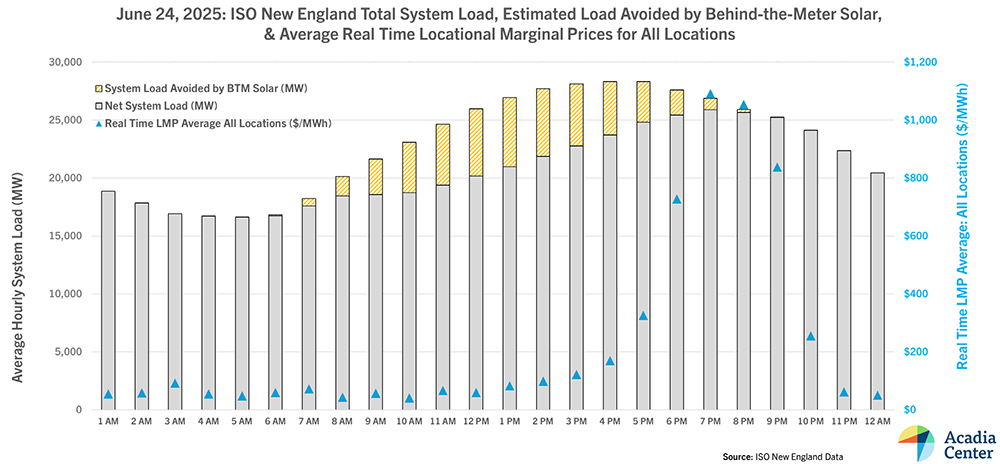
Without BTM solar, demand would have peaked at about 28,400 MW in the mid-afternoon, instead of about 26,000 around 7 p.m.
Meanwhile, during the June 24, 2025, heat wave, BTM solar suppressed wholesale costs by as much as $19.4 million, according to an Acadia Center analysis.
To read the full article from RTO Insider, click here.