



















Between January 24 and February 1, 2026, the northeast U.S. and eastern Canada faced an exceptionally cold period brought on by Winter Storm Fern and a pair of accompanying waves of Arctic air. The nature and duration of these extreme conditions challenged energy reliability, affordability, and decarbonization alike. The broad region survived the cold-snap without widespread impacts to reliability, but keeping the lights and heat on came at a significant cost, with January the costliest month in ISO-NE history.
Weeks like these are and will remain the biggest test for the region’s evolving energy systems. But it’s vital to understand that the pain-points seen are byproducts of the legacy energy systems that have been in place for decades and which must be transitioned away from. Policymakers and stakeholders across the integrated energy systems of the broad Northeast must learn lessons from this past week about how to perform more efficiently and resiliently to challenging weather conditions. This Grid Action Report provides four key takeaways to inform future planning, investment, and operation of the region’s energy systems.
1. The Critical (and Invisible) Role of Energy Efficiency
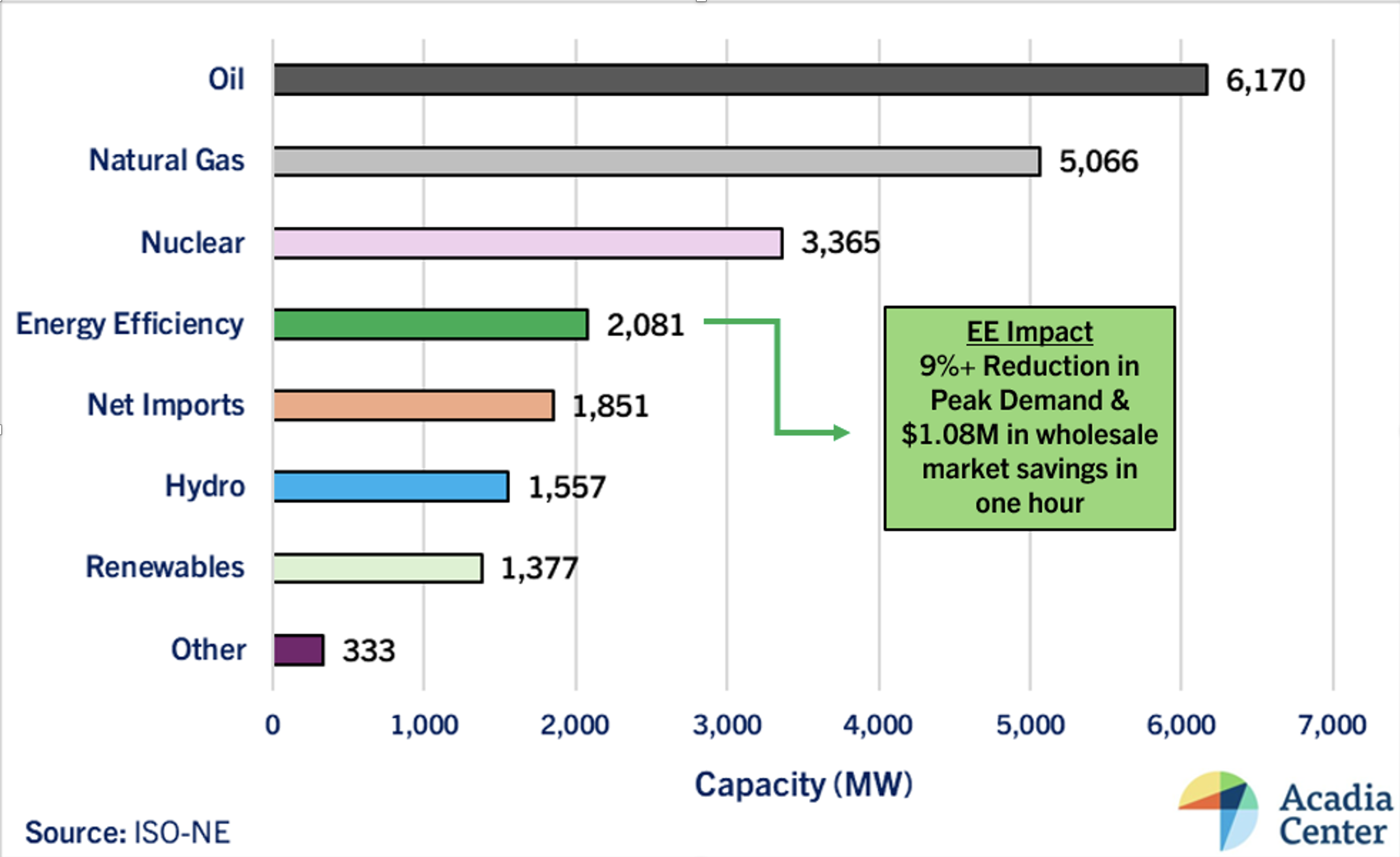
Energy efficiency resources in New England contributed 2+GW of capacity during the winter peak, saving more than $1 million per hour
At 1pm on January 25, the grid hit its seasonal peak of 20,157 MW. That and the following day, day-ahead market prices exceeded $520/MWh around 6pm in the evening. Based on Forward Capacity Auction (FCA)-18, the region’s latest capacity auction, energy efficiency was passively reducing demand by 2,081 MW at this time. Without it, the grid would have needed to rely more heavily on oil. With a $520/MWh cost at the January 26 peak, energy efficiency was generating over $1.08 million in wholesale market savings during that hour alone. When factoring in efficiency’s contributions (not shown in most resource mix data), almost half the capacity keeping New England’s lights on was zero- to low-emissions, even on the peak of this winter’s most difficult day.
Figure 1. Capacity Serving ISO-NE During Winter Peak by Resource Type: January 26th 5:52 PM
Proposals to cut budgets or otherwise constrain Mass Save and other energy efficiency programs will only hamstring the region’s ability to generate wholesale market savings in this manner, leading to increasing ratepayer bills. The cold-snap evidences just how critical energy efficiency remains.
In New England and beyond, and there are still extensive amounts of low-hanging fruit and low-cost EE savings to be reaped across the region and in Canada specifically. For example, the Save on Energy program portfolio in Ontario delivered 3.57 TWh (million MWh) of energy savings between 2021 and 2024 at the extremely low cost of less than three cents per kWh – at a time when most new generation projects may struggle to pencil out for anything less than ten cents/kWh. So many more energy efficiency resources remain to be tapped.
2. The Immense Opportunity (and Urgency) of Re-Electrifying Space Heating
Converting electric resistance to heat pumps could lower demand by 20+ GW
New England and New York’s grids are part of a larger interconnected grid that includes neighboring provinces in Eastern Canada (together making up the Northeast Power Coordinating Council, or NPCC). Part of the reason why the cold-snap placed the system under so much stress was because of the bitter cold endured in Quebec and neighboring Newfoundland and Labrador, where widespread resistance-based electric heating makes the grid winter-peaking (in contrast to the summer-peaking New England and New York grids). Driven by longstanding cheap electricity rates, a remarkable 54-56% of households in these regions still rely on electric baseboard heating – the main reason why residential demand drives some 50% of peak winter load in Quebec. That winter peak surpassed 40.6 GW on January 25, exceeding available local generation capacity.
Electric resistance heating is deeply inefficient compared to modern cold-climate heat pumps, both on an annual basis (kWh) and in terms of peak demand (kW). During the course of a heating season in New England, the coefficient of performance (COP) of a heat pump is around 2.6 to 2.7, meaning that it’s about 2.6–2.7 times more efficient than electric resistance heating. Even though the efficiency of heat pumps decreases during periods of extreme cold, heat pumps still typically operate at a COP of about 2.0 during the coldest hours of New England winter (when the average thermostat in the region hovers around 5°F). [1] As a result, in New England Climate Zones, the inefficiency of electric resistance heating is so stark that switching from resistance heating to a heat pump can reduce wintertime energy consumption by 50%. The same ratio holds true from a peak-demand perspective: an average whole-house heat pump in Greater Boston would be expected to have a winter peak of about 5.28 kW during a near-zero-degree Fahrenheit event (based on real-world data from this cold-snap), 50% below an estimated 10.56 kW peak demand for electric resistance.
In Quebec alone, this math presents a game-changing opportunity. If even half of the roughly 2 million households currently relying on electric resistance heating were to convert to heat pumps, that would mean potential wintertime peak demand relief of 5,346 MW, or 13% of the Quebec’s peak on January 25. This magnitude of heat pump retrofits would obviously require major investment and years to fully realize (and some incentives are available), but it would also save enormous amounts of money for electric customers in reduced market and fuel costs and avoided power plants and transmission capacity.
The theoretical winter on-peak savings opportunity for baseboard-to-heat pump retrofits across the entire NPCC region (plus Newfoundland and Labrador) is enormous: with almost 4.5 million households heated by electric baseboard heating today, upwards of 20 GW of winter peak demand could be avoided with heat pump retrofits, out of a regional peak of roughly 112 GW forecast for this winter. The region must seize this monumental potential and make re-electrification efforts a central strategy to solve for reliability, affordability, and decarbonization in future winter cold-snaps.
3. Strong Winter-Peaking Output from Offshore Wind
The window into what could have been (and what will one-day become)
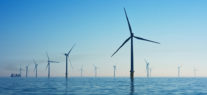
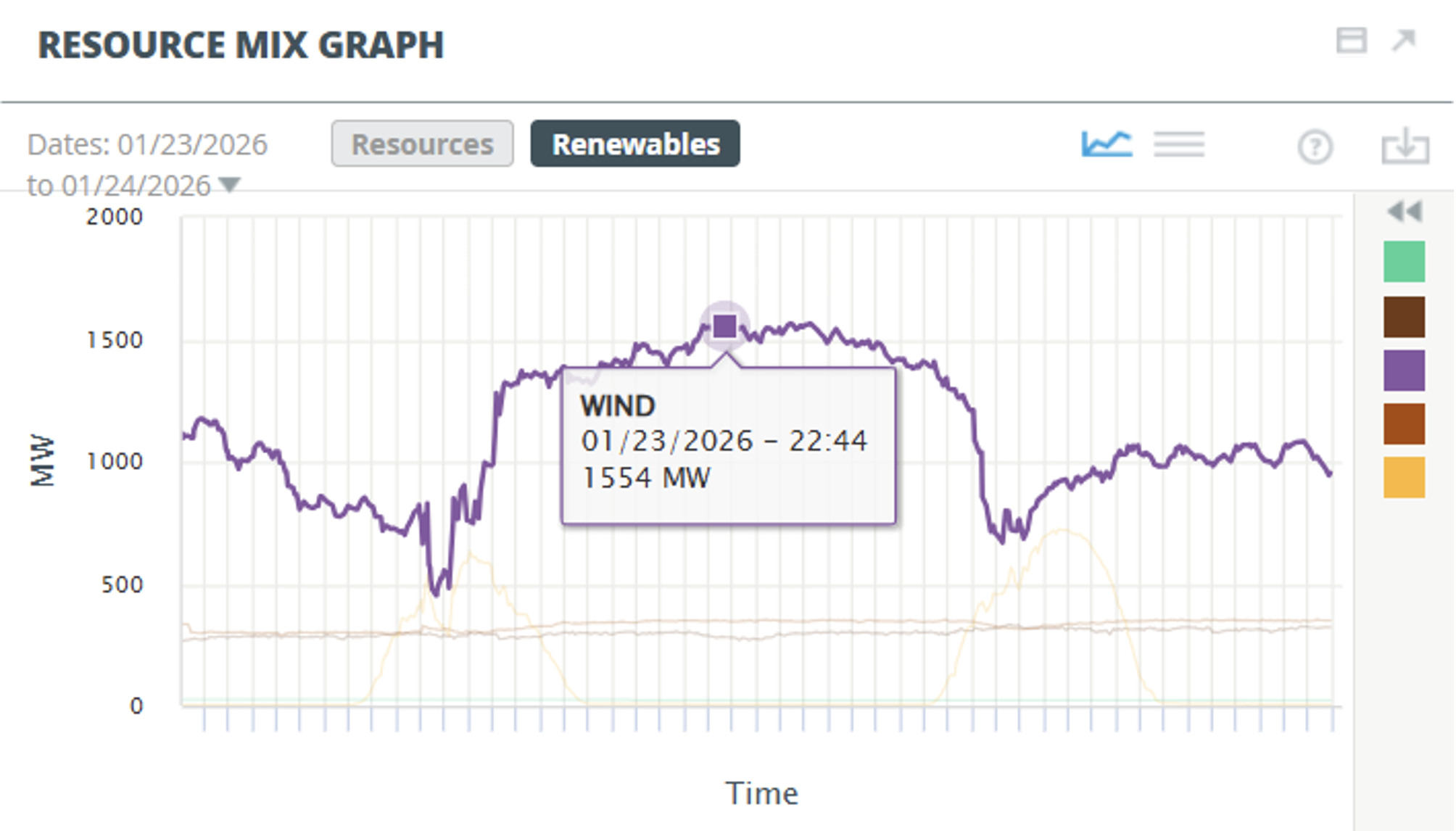
Vineyard Wind and other operational offshore wind projects performed capably during the cold-snap, harnessing strong wind speeds to churn out near record-setting production peaks during a period of considerable grid stress. Wind generation peaked during the cold-snap at 1,565 MW, notching two separate top-five production peaks in regional wind generation to-date. This type of production corroborates findings that offshore wind would have saved New England ratepayers at least $400 million in utility bill costs last year, lowering energy market prices by 11% and insulating ratepayers from expensive, volatile natural gas markets. Overall wind production during the month of January was up by about 18% year-over-year despite some extended low-wind periods onshore. This provides strong evidence for the offshore wind benefits yielded by foundational Renewable Portfolio Standard (RPS) and long-term contracting policies, which must stay on the books. In neighboring New York, production from the South Fork Wind Farm also contributed capably, helping set NYISO’s all-time record wind production in mid-January and deliver more than 1.5 GW of wind on January 25 and 26.
Figure 2. Wind Production Peaks in ISO-NE During Recent Cold-Snap
Strong cold-snap wind production coincided with the final remaining court decisions ruling in favor of the five active offshore wind projects up and down the Atlantic Coast, following baseless efforts to delay and cancel projects by the Trump Administration. The performance of these projects during a historic period of grid stress should be all the evidence any court or regulator should need about the importance of the nation’s offshore wind resources and the wisdom of states’ efforts to bring these generation resources forward. Other positive winds are blowing for offshore wind further north up the Atlantic coast, too, with Massachusetts and Nova Scotia signing a Memorandum of Understanding to advance offshore wind, grid planning, supply chain, and beyond as Atlantic Canada looks to begin in earnest its efforts to tap into world-class, terawatt-scale wind resources.
Finally, while wind made waves, it is worth acknowledging that January solar production was down some 25% year-over-year, due in large part to the higher levels of snow coverage affecting panel output across the region. This phenomenon is well known and accounted for in grid modeling and demand-forecasting exercises (and, in the future can be mitigated with vertical panel-mounting). Nonetheless, even at somewhat reduced levels of output, solar did play a critical fuel-saving and replenishment function, with each MWh of solar output preventing oil and gas burn and allowing power plants to refill fuel inventories – critical to preserving resource adequacy as the extended cold-snap diminishes oil reserves (with 66 million gallons of oil burned in January).
4. Dynamic Support from a New Interregional Transmission Line
Interregional transmission, planning can supports neighbors’ reliability
Power demand approached 110 GW on the integrated grid reliability region, ranking the cold-snap among the highest combined winter demand periods in NPCC history. The exceptional cold was such that HydroQuebec’s peak load exceeded its 50/50 winter forecast by over 200 MW (0.5%) on January 25. A changing climate will only make aberrational winter cold events more common in the future, due to factors like the weakening jet stream.
The cold-snap came shortly on the heels of the New England Clean Energy Connect (NECEC) transmission line coming online, after a decade-long process to bring forth new interregional transmission capacity to carry hydropower from Quebec into Massachusetts. The positive impact of the line had been seen almost immediately on wholesale power prices in Massachusetts and across New England, providing 6-8% of the region’s power needs and substantially reducing natural gas generation. During the toughest peak of the cold-snap for Quebec, however, flows on the NECEC line reversed to bring power from New England into Quebec, where surging electricity demand brought the most severe stress and operational concerns. HydroQuebec incurred significant financial penalties for not delivering power into Massachusetts (returning some money back to Massachusetts ratepayers), which speaks to the severity of the challenges in meeting local demand.
Despite this, the availability of the line meant that it was able to help maintain reliability in both regions during the cold-snap. The NECEC reduced fuel burn in New England over much of the cold-snap but at times also exported to Quebec, allowing the province to benefit from excess generation capacity in summer-peaking New England (even tough oil was being relied on for fuel). For added context, New England and New York have long supported Quebec during winter peaks – including during Quebec’s all-time peak in February 2023.
Contrary to some coverage, the takeaway is not that ‘Canada isn’t going to save us’ – the neighboring regions’ fates are already tied together by the grid. The lesson to be learned is that transmission linkages can offer two-way reliability support to neighboring regions during periods of remarkable stress. Looking ahead, more proactive, integrated transmission planning and procurement across a broad unified footprint (NPCC) will be critical to improving the connectivity of neighboring grids and fairly sharing the costs of new transmission lines among all beneficiaries, rather than via bilateral contracts. And by factoring in demand-side drivers, like the immense peak reduction opportunities described above, neighbors can collaborate to open up many gigawatts of headroom to ensure that power can flow year-round to wherever it is needed most via current and future tie-lines. This is the holistic vision for the Northeast Grid Planning Forum (NGPF), co-convened by Acadia Center and Nergica – find out more about that project and learn how to get involved here.
Media contacts: info@acadiacenter.org.
[1] Gibb, et. al, 2023. “Coming in from the cold: Heat pump efficiency at low temperatures”. https://www.sciencedirect.com/science/article/pii/S2542435123003513