



















Putting Costs in Context in Connecticut
Media Contacts:
Kate McAuliffe, Senior Policy Advocate, Connecticut
kmcauliffe@acadiacenter.org, 860-246-7121 x202
Noah Berman, Senior Policy Advocate, Utility Innovation Program Manager
nberman@acadiacenter.org, 617-742-0054 x107
Executive Summary
- Eversource justifies its solar project cancellation via a misleading focus on comparatively miniscule solar contract costs, ignoring full savings and other larger cost drivers. The utility’s refusal to execute contracts with 54 MW of new solar capacity upends the state’s proper role and conflicts with clear, long-established policy mandates.
- While renewables are often scapegoated as a driver of the Northeast’s high electricity prices, the data shows the opposite is true. The proposed solar capacity from this multi-state RFP is projected to save ratepayers $80 million over twenty years. It is therefore Eversource’s decision not to enter into these contracts that will increase customer costs, not the contracts themselves.
- A recent FERC Order reduced New England transmission owners’ allowed return on equity (ROE) and ordered refunds to ratepayers. Rather than provide ratepayers real relief, Eversource and Avangrid have asked FERC and the U.S. Court of Appeals to stay the $1.5 billion refund decision – including $500+ million dollars due to Connecticut ratepayers.
- Other major drivers of customer costs attributable to Eversource’s transmission and distribution businesses (single-year figures) dwarf the gross costs cited for the solar contracts ($238m over twenty years), including: $300m in transmission re-build expenses in Connecticut; $667m in regional distribution-level profits; and $483m in power supply costs at $155 per megawatt-hour (MWh).
- States with more penetration of renewables have seen smaller electricity price increases over the past twenty years, while states that depend more heavily on natural gas have seen higher electricity price increases. Studies have also consistently shown that renewables save customers money by reducing wholesale electricity prices, especially during extreme weather and global fuel volatility like we’re experiencing today.
On December 18, 2025, the Connecticut Department of Energy and Environmental Protection (DEEP), in collaboration with Massachusetts, Maine, and Vermont, announced the selection of 173 MW of new solar projects that will being clean, affordable energy to the region.[1] This regional effort was designed to bring costs down for ratepayers, improve grid reliability, and allow states to take advantage of federal tax credits before their untimely expiration. The three solar projects selected by Connecticut would provide enough electricity to power 12,000 homes, save ratepayers an estimated $80 million over a twenty-year contract period, and contribute to Connecticut’s requirement of achieving a zero-carbon electric sector by 2040.[2]
The future of these projects was called into question on March 27, 2026, when Eversource submitted a letter indicating that it was declining to enter into contracts for its 54 MW share.[3] According to the letter, Eversource made this “difficult” decision in the interest of ratepayer costs, citing the affordability of power purchase agreements (PPAs) and a lack of long-term planning for Connecticut’s renewable portfolio. Eversource’s attempt to ignore estimated savings and opt-out of these contracts is unwarranted and threatens to risk other participating states’ procurements, potentially depriving ratepayers of affordable, clean, locally based and reliable energy.
Unpacking the Double Standard Applied by Eversource
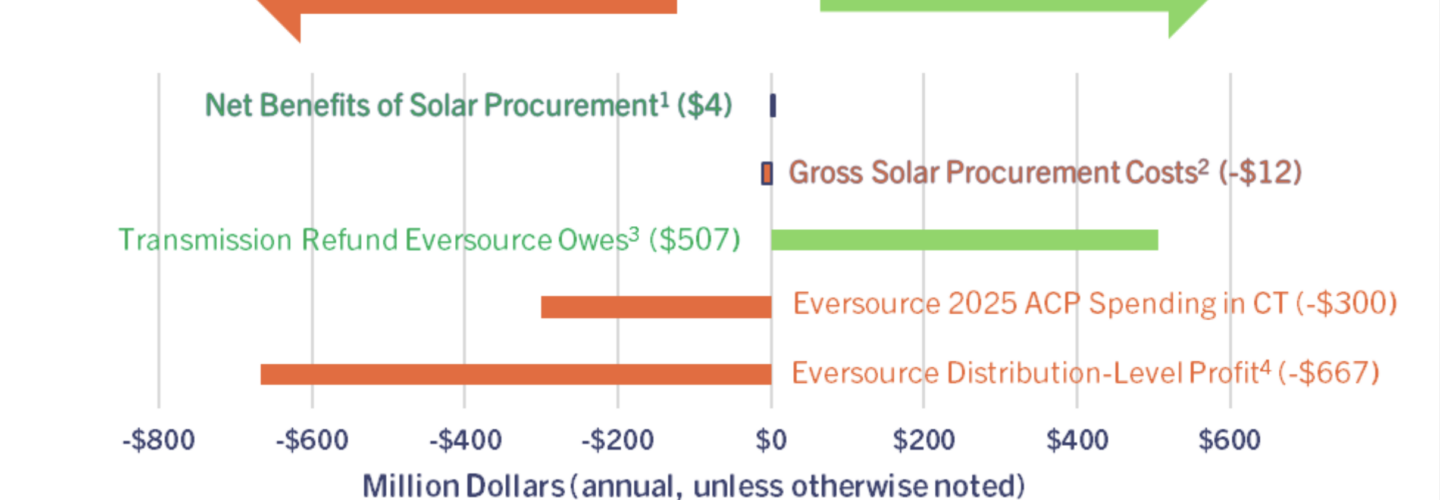
While Eversource’s letter suggests a desire to conduct procurements through a “much-needed affordability lens,” the Company unfortunately does not apply the same level of concern to much larger costs in other areas of customer bills. For starters, as illustrated above, the gross annual costs of the solar projects are miniscule in comparison to other savings opportunities, and that is without the consideration of net benefits from the projects’ price effects in wholesale electricity markets, which outweigh the costs entirely.
Figure 1: Comparison of Solar Procurement Costs/Benefits With Other Major Energy Cost Drivers
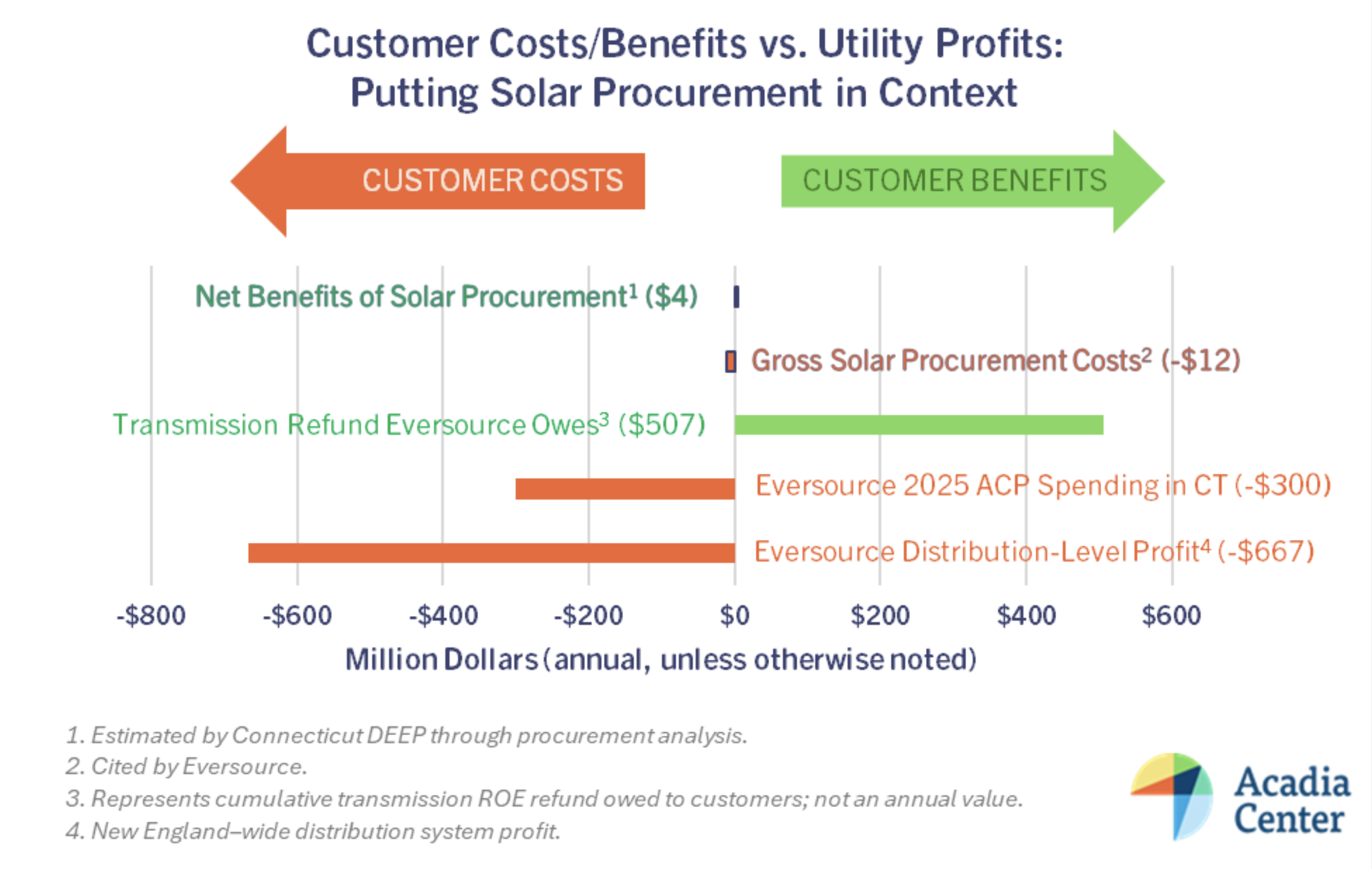
In addition, a recent Federal Energy Regulatory Commission (FERC) Order – issued just eight days before Eversource’s letter refusing to execute the solar contracts – reduced New England transmission owners’ allowed return on equity (ROE) and ordered refunds to ratepayers, concluding the utilities’ rates were “unjust and unreasonable.” Rather than use this opportunity to provide ratepayers real relief, Eversource and Avangrid have asked FERC and the U.S. Court of Appeals to stay the $1.5 billion refund decision.[4],[5] For Connecticut Light and Power ratepayers, the total refund appears to amount to around $507 million, before carrying costs.[6] And yet, Eversource, with Avangrid, has filed a motion to stay its obligation to pay this refund, prolonging litigation that began in 2011 (filed by Acadia Center, then called Environment Northeast, in cases consolidated with ones brought by the Massachusetts Attorney General and others[7]) in order to avoid responsibility for refunding customers. Eversource’s decision not to refund its customers half a billion dollars ordered by its federal regulator is not in keeping with a purported focus on “protect[ing] the interests of customers.[8]
In arguing to stay the refund, Eversource and the other utilities cite “downstream harms to customers, who ultimately bear the increased financing costs resulting from negative credit impacts,” among others (Motion at 4). At best, it is speculative that the resulting 9.57% Return on Equity (ROE) will result in negative credit rating impacts that harm customers; at worst, it is a misleading argument frequently made by utilities to avoid reductions in allowed profits. In practice, even utilities undergoing active bankruptcy filings – a much more perilous financial circumstance than Eversource here faces – have been able to access capital from investors.[9]
Even more glaring, Eversource has not raised any objections to the lack of planning/policy direction when it comes to the oversight and regulation of what are called Asset Condition Projects (ACPs) – a type of transmission project that has until recently received so little regulatory oversight that none has ever been modified or rejected in New England.[10] These projects, which are largely rebuilds of existing assets, are widely acknowledged to be driving substantial cost increases in customers’ transmission bills. In 2025, $300 million dollars’ worth of Eversource ACPs went into service in Connecticut, according to ISO New England’s Asset Condition List. Even though there has been no coherent policy at the state or region level monitoring these assets to ensure the investments are “aligned with state policy and affordability objectives,” as the Company writes in its letter, Eversource does not show similar high-mindedness by reining in its own ACP spending. Rather, from 2022 to 2024, Net Income Attributable to Common Shareholders (or ‘profits’) recovered by Eversource’s regional holding company (not the subsidiary in Connecticut) for electric transmission rose from $596.6M to $724.6M, an increase of $128M in two years.[11]
This, compared to an annual gross project cost of $11.9 million ($238m/20 years) for these three solar procurements that Eversource has declined to procure. It is noteworthy that Eversource cites the gross lifetime cost rather than the annual cost or the lifetime net benefits because, on an annual basis, these procurements are a very small amount of money to a very large company – hardly “an unreasonable burden on the respective EDC’s balance sheet.”[12] Nowhere does Eversource mention the net benefits to ratepayers. Indeed, the customer bill benefits cited by DEEP – some $80m in net lifetime ratepayer bill savings from energy sales and the market impacts of lower energy and capacity prices – make it clear that these procurements actually have the overall impact of decreasing customer bills, rather than increasing them.[13] Viewed in this light, it is Eversource’s decision not to enter into these contracts that will increase customer costs, not the contracts themselves.
Eversource claims in their letter that the contract pricing is over-market. However, an examination of Eversource’s recent regulatory filings reveals at least one other power supply contract of similar if not higher levelized cost than the solar PPAs (detailed pricing not yet public). Specifically, in Eversource’s April 30, 2025, FERC Form 1 filing to PURA, the Company identified it had purchased 3,121,301 megawatt-hours (MWh) from Constellation for standard offer service, paid for at $483,497,108 in one year – or approximately $155 per MWh.[14] While these payments were made for a specific supply product different from the solar PPAs (energy and RECs), the total expenditure is vastly larger, and the levelized cost again seems likely to be of similar if not higher cost. In both cases, Eversource passes on 100% of costs to customers, and yet it chose to dispute the vastly smaller (and possibly cheaper) solar contracts – calling into question what standard is being applied, and when.
While renewables are often scapegoated as a driver of the Northeast’s high electricity prices, the data shows the opposite is true. States with more penetration of renewables have seen smaller electricity price increases over the past twenty years, while states that depend more heavily on natural gas have seen higher electricity price increases.[15] Studies have also consistently shown that renewables save customers money by reducing wholesale electricity prices, especially during extreme weather and global fuel volatility like we’re experiencing today.[16]
Cancellations Threaten Bill Increases and Regional Affordability Efforts
With other sources of generation increasingly expensive and volatile, large solar projects like the ones selected in this RFP are an affordability imperative. Expiring federal tax incentives have the potential to reduce project costs by about a third.[17] After the Trump administration cut federal tax credits starting July 2026, DEEP and its regional partners acted fast to procure resources at the lowest possible cost. Abandoning these projects in the name of affordability will raise prices.
Eversource’s justification for pulling out of the contracts is not only flawed, but it also sets a bad precedent and could impact future multi-state procurement efforts. If Eversource is able to walk away from procurements that are clearly in the interest of ratepayers and aligned with state policy mandates, then DEEP’s statutorily provided procurement authority is thrown into question. If this situation holds, the Company, rather than state policymakers, is in the position to pick and choose projects. This simply must not be permitted.
Other states participating in this procurement may now be left in the lurch. It is not clear what will happen to the 54 MW allocated to Eversource, but if there is even a slight delay in these projects being developed (e.g., to realign project financing after a major partner drops out), they will likely miss the deadline for eligibility for the tax credits, scuttling project financing estimates entirely. In a time of rising electricity demand, Eversource’s walking away could block over 100 new, clean MW from coming online, possibly souring other states from wanting to join on similar procurements in the future. This would be deeply unfortunate because multi-state procurements are often the most efficient and lead to the lowest cost projects, plus the ability to share costs. Additionally, because the energy market in New England is regional, if other states choose not to engage with Connecticut because Eversource has shown itself to be an unreliable partner, that hurts all ratepayers in the region.
While Eversource’s assertions about affordability are misleading at best, the Company is correct that Connecticut is several years behind in its development of key planning documents, including the Comprehensive Energy Strategy (CES) and Integrated Resources Plan (IRP). According to Eversource, without these frameworks, they cannot know whether the contracts are “aligned with overall state policy and affordability perspectives.” This is a meritless excuse of massive proportions. Connecticut has long-established and clear policy mandates for the electricity sector, including a binding requirement to be zero-carbon by 2040. DEEP has conducted other zero-carbon procurements, including two in 2023, without similar objections from Eversource.[18] Indeed, according to DEEP, Eversource participated in this procurement and “voiced no concerns or objections at any point of the evaluation and selection process.”[19] Sadly, this suggests that the late protests and refusal to execute contracts was a decision not made in good faith.
Conclusion
Large-scale, competitively procured solar projects present a compelling value proposition for Connecticut ratepayers: clean, affordable, and reliable energy that is not subject to the volatility of fossil fuel generation. Connecticut and its regional partners acted quickly to bring these projects online with the added benefit of federal tax credits. At the eleventh hour, and without clear justification or authority, Eversource has put these projects in jeopardy in the misleading name of affordability, while conveniently ignoring or actively blocking other opportunities to provide ratepayer relief. Permitting Eversource to back out of these contracts threatens Connecticut’s ability to procure clean energy resources in the future and will cost ratepayers in the near and long term.
For more information:
• Acadia Center’s Fact Sheet Collection: Energy Cost Drivers
• Op-Ed: An Independent Transmission Monitor Could Cut Ratepayer Costs (CT Mirror)
[1] Connecticut Department of Energy and Environmental Protection, Connecticut and New England Partners Announce Clean Energy Selections, December 18, 2025: https://portal.ct.gov/deep/news-releases/news-releases—2025/connecticut-and-new-england-state-partners-announce-clean-energy-selections
[2] Public Act No. 22-5: https://www.cga.ct.gov/2022/ACT/PA/PDF/2022PA-00005-R00SB-00010-PA.PDF
[3] Eversource Energy letter regarding 2025 Expedited Zero Carbon Contracts, March 27, 2026: https://www.documentcloud.org/documents/28029972-letter-response-on-long-term-clean-energy-procurement-in-ct-32726-copy/?mode=document
[4] Howland, Ethan. “Eversource, Avangrid ask FERC to stay $1.5 billion refund decision.” Utility Dive. April 7, 2026: https://www.utilitydive.com/news/eversource-avangrid-ferc-roe-refund-iso-ne/816797/
[5] Howland, Ethan. “New England states urge FERC to advance $1.5B in ratepayer refunds.” Utility Dive . April 21, 2026: https://www.utilitydive.com/news/new-england-nescoe-ferc-roe-transmission-avangrid-eversource/818040
[6] Calculated based on subsidiary-level obligations identified in Connecticut Light and Power’s FERC Form 1 , Section E ,“ FERC ROE Complaint” and Eversource’s overall estimated obligation identified in the Company’s Motion for a Stay of Retroactive Refund Obligations , FERC Docket Nos. EL11 – 66 – 001, EL11 – 66 – 004, EL11 – 66 – 005 .
[7] ENE (Environment Northeast) v. Bangor Hydro-Electric Company (docket EL13-33)
[8] Eversource Energy letter regarding 2025 Expedited Zero Carbon Contracts, p. 1
[9] PG&E Corporation – PG&E Completes Initial Stage of Bankruptcy Exit Financing
[10] Though ISO-NE has begun a process to improve ACP oversight by instituting an Asset Condition Project Reviewer, which will hopefully meaningfully increase scrutiny.
[11] Connecticut Power and Light FERC Form 1, page 43
[12] Eversource Energy letter regarding 2025 Expedited Zero Carbon Contracts, p. 3
[13] Moritz, John. “Eversource backs out of three solar projects supported by state.” Connecticut Mirror . April 8, 2026: https://ctmirror.org/2026/04/08/eversource-backs-out-solar-agreements-deep/
[14] CPL FERC Form 1, page 94
[15] Acadia Center, Renewables Aren’t Behind Energy Cost Increases, Winter 2026: https://acadiacenter.wpenginepowered.com/wp-content/uploads/2026/01/AC_FactSheet_Renewables_R3.pdf
[16] Id.
[17] Berkeley Lab, Utility-Scale Solar, 2024 Edition: Empirical Trends in Deployment, Technology, Cost, Performance, PPA Pricing, and Value in the United States, October 2024: https://emp.lbl.gov/publications/utility-scale-solar-2024-edition
[18] See DEEP’s 2023 Zero-Carbon Procurement: https://www.dpuc.state.ct.us/DEEPEnergy.nsf/$EnergyView?OpenForm&Start=1&Count=30&Expand=3&Seq=3 and 2023 Offshore Wind Procurement: https://www.dpuc.state.ct.us/DEEPEnergy.nsf/$EnergyView?OpenForm&Start=1&Count=30&Expand=2&Seq=4
[19] “Eversource backs out of three solar projects supported by state.” https://ctmirror.org/2026/04/08/eversource-backs-out- solar-agreements-deep/